
WE'LL BE HAPPY TO HELP, CALL US TODAY!
215-607-6688
A Practical Field Guide to Behr Premium Concrete Paint
A Practical Field Guide to Behr Premium Concrete Paint
Is BEHR PREMIUM Concrete Paint a Good Choice for Your Floor?
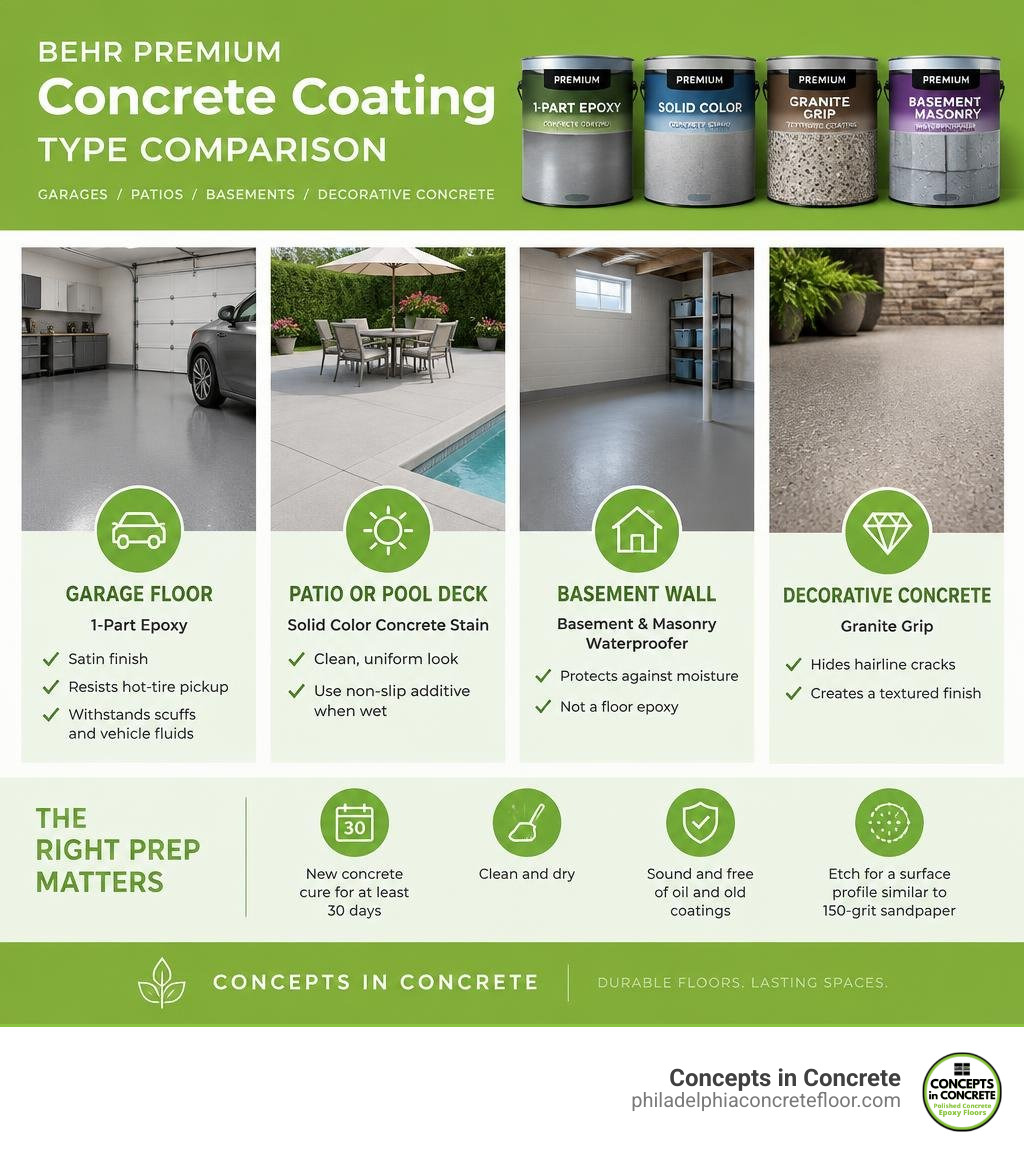
BEHR PREMIUM concrete paint can be a practical DIY option for properly prepared, low-to-moderate traffic concrete. Its 1-Part Epoxy is the stronger choice for garage floors, driveways, and other horizontal areas that see tires, oil, and scuffs. Its Solid Color Concrete Stain is better for a flat, uniform look on patios, walkways, and indoor or outdoor concrete where a softer finish is preferred.
Before choosing a product, match it to the job:
- Garage floor: Choose 1-Part Epoxy for its satin finish and resistance to hot-tire pickup, scuffing, and common vehicle fluids.
- Patio or pool deck: Consider Solid Color Concrete Stain, and use a non-slip additive where the surface can get wet.
- Basement wall or masonry wall: Use a dedicated basement and masonry waterproofer, not a floor epoxy.
- Decorative or textured concrete: Consider Granite Grip, a specialty coating designed to help hide hairline cracks and create a textured finish.
The important catch is preparation. New concrete should cure for at least 30 days. Existing slabs need to be clean, dry, sound, free of oil and old failing coatings, and etched to create a surface profile similar to 150-grit sandpaper. Even a quality coating can peel when moisture, contamination, or weak concrete is left underneath.
I am John Muldoon, President of Concepts in Concrete, with more than 23 years of construction experience managing epoxy flooring, polished concrete, repairs, and resurfacing projects from home garages to 100,000-square-foot facilities. In this guide, I will assess where BEHR PREMIUM concrete paint makes sense, where its limits appear, and when a professional-grade flooring system may be the better long-term investment.
Behr premium concrete paint helpful reading:
Overview of BEHR PREMIUM Concrete Paint and Coating Lineup
When tackling a concrete upgrade at home, navigating retail coating options can get confusing quickly. The BEHR PREMIUM concrete line spans several distinct chemical families, each engineered for specific environmental stresses, substrates, and aesthetic outcomes.
Rather than treating every concrete slab identically, the lineup divides into film-forming single-part epoxies, penetrating siliconized acrylic stains, aggregate-filled texture coats, masonry barrier coatings, and clear protective sealers. Understanding these distinctions ensures you do not end up with peeling paint under your tires or trapped moisture bubbling inside your basement slab.
| Product Name | Formulation Base | Finish Type | Spread Rate (Per Gallon) | Recommended Surfaces | Average User Rating |
|---|---|---|---|---|---|
| Interior/Exterior 1-Part Epoxy | Water-based Acrylic Epoxy | Satin Enamel | 300–400 sq. ft. (rough) 400–500 sq. ft. (smooth) |
Garages, driveways, porches, residential slabs | 4.2 / 5 |
| Solid Color Concrete Stain | 100% Siliconized Acrylic | Flat / Matte | 400–500 sq. ft. (rough) 500–600 sq. ft. (smooth) |
Patios, walkways, pool decks, vertical masonry | 4.5 / 5 (217 reviews) |
| Granite Grip | Heavy-Bodied Acrylic / Aggregates | Textured Stone | ~50 sq. ft. (2 coats required) | Porches, steps, walkways with hairline cracks | 3.9 / 5 |
| Dry Plus Masonry Waterproofer | Acrylic Latex Barrier | Flat | 75–125 sq. ft. | Basement walls, retaining walls, masonry block | 4.5 / 5 (440 reviews) |
| Color Enhancing Sealer | Penetrating Silicone / Siloxane | Natural Wet Look | 175–400 sq. ft. | Pavers, flagstone, unglazed stone, brick | 4.4 / 5 (859 reviews) |
| Low-Lustre Sealer | Water-based Acrylic Sealer | Low Sheen | 200–450 sq. ft. | Interior/exterior decorative concrete, stamped slabs | 3.8 / 5 (2,971 reviews) |
Evaluating BEHR PREMIUM Concrete Paint: 1-Part Epoxy vs. Solid Color Stain
The two most common choices for residential flatwork are the Interior & Exterior Concrete Garage Self-Priming 1-Part Epoxy Coating | BEHR PREMIUM and the Solid Color Concrete Stain | BEHR PREMIUM® | Behr. Homeowners frequently ask which formula holds up better over time.
The 1-Part Epoxy is a single-component, water-borne acrylic-epoxy hybrid. It forms an opaque, continuous surface film with a subtle satin sheen. Because it includes epoxy resins, it delivers enhanced chemical resistance against engine oil, gasoline, antifreeze, and scuffing from regular foot traffic. This makes it BEHR’s flagship retail choice for car parking zones and workshop spaces.
In contrast, the Solid Color Concrete Stain is a 100% siliconized acrylic coating engineered with a dead-flat finish. Instead of sitting purely on top of the concrete as a thick shell, its lower-viscosity siliconized formula penetrates deeper into the open pores of the substrate while retaining water repellency. It is significantly more breathable than an epoxy film, making it less prone to moisture blistering on exterior outdoor flatwork exposed to rain and sun cycles. When choosing the right concrete coating for durability, reserve the 1-Part Epoxy for vehicle traffic areas and select the Solid Color Stain for exterior pedestrian surfaces like patios and sidewalks.
Specialty Formulas: Granite Grip, Waterproofers, and Enhancers
Beyond standard paints and stains, BEHR provides specialty products addressing unique structural and aesthetic challenges:
- Granite Grip: A high-build, aggregate-filled coating that transforms worn concrete into a multi-toned, speckled granite finish. It is specifically formulated to bridge and fill hairline cracks up to 1/16-inch wide, making it useful for refreshing weathered porches and walkways.
- Dry Plus Basement & Masonry Waterproofer: Available in ready-mix white or pre-tinted gray (such as #876 Basement Gray, boasting an average rating of 4.6 from 156 reviews). It is engineered specifically to withstand negative-side hydrostatic water pressure on vertical masonry, concrete blocks, and retaining walls.
- Clear and Penetrating Sealers: Products like the BEHR PREMIUM® Color Enhancing Sealer for Concrete & Masonry | Behr penetrate deeply into porous masonry, flagstone, and unglazed pavers. They deepen the natural hues of the aggregate while providing reliable water and stain repellency without creating a slippery topical film.
Step-by-Step Preparation and Application for BEHR PREMIUM Concrete Paint
Any veteran flooring contractor will tell you: a coating is only as strong as the concrete underneath it. The vast majority of DIY paint failures occur because surface prep was rushed.
Before picking up a roller, ensure the concrete meets these baseline requirements:
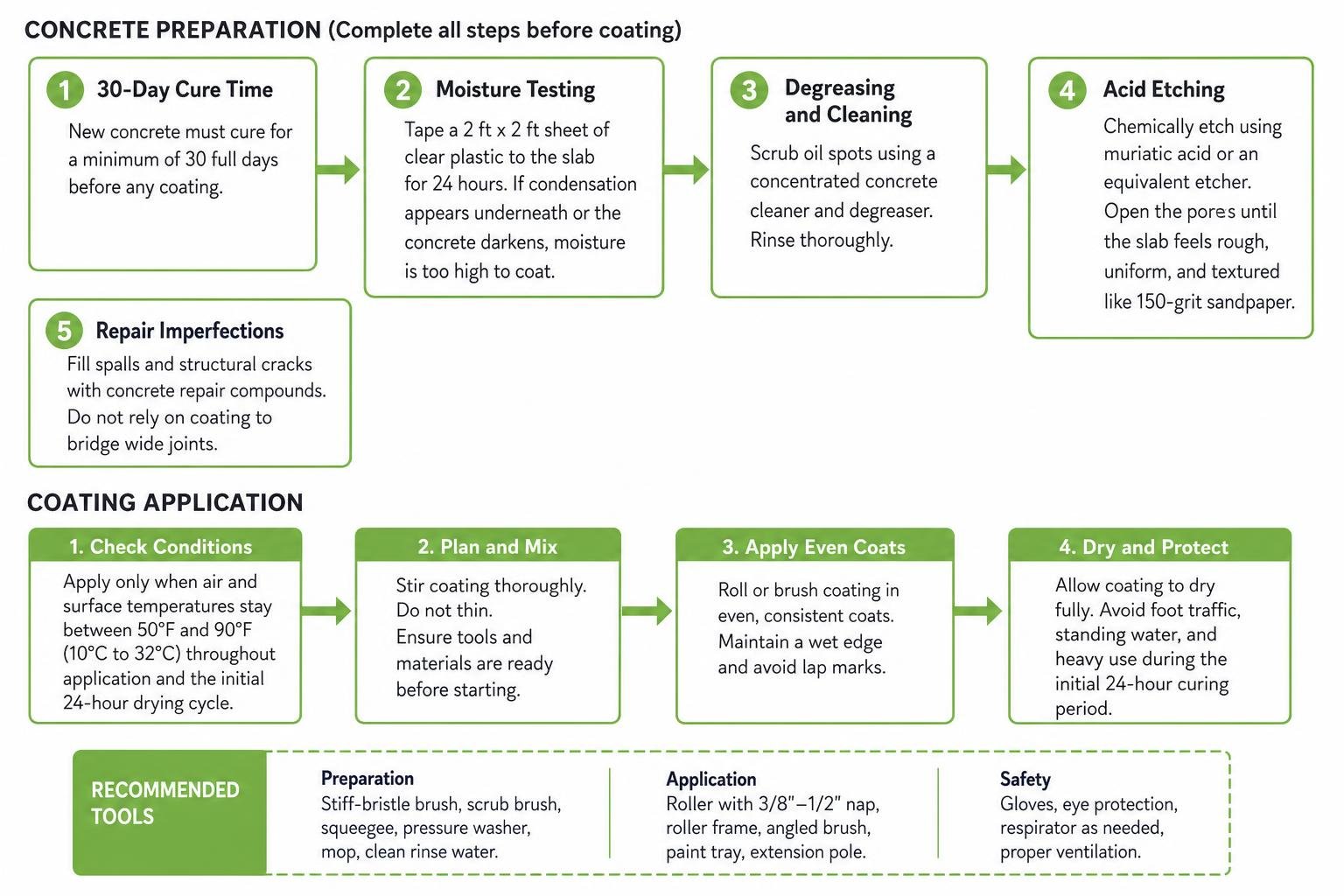
- 30-Day Cure Time: Brand new concrete releases excessive moisture and caustic lime as it cures. It must cure for a minimum of 30 full days before applying any paint, stain, or sealer.
- Moisture Testing: Tape a 2-foot by 2-foot sheet of clear plastic tightly to your slab with duct tape. Wait 24 hours. If condensation appears on the underside of the plastic or the concrete darkens, significant moisture vapor is pushing upward through the slab. Topical retail paints will likely blister in these conditions.
- Degreasing and Cleaning: Scrub oil spots using a concentrated concrete cleaner and degreaser. Rinse thoroughly, as residual grease acts as a permanent bond breaker.
- Acid Etching: Uncoated concrete must be chemically etched using muriatic acid or an equivalent phosphoric concrete etcher. The objective is to open the pores until the slab feels rough, uniform, and textured like 150-grit sandpaper.
- Addressing Surface Imperfections: Fill spalls and deeper structural fractures using dedicated concrete repair compounds rather than relying on paint to bridge wide expansion joints.
Application Guidelines and Tool Selection
Applying concrete coatings correctly requires adherence to temperature boundaries and specific application tools:
- Environmental Windows: Apply only when air and surface temperatures stay strictly between 50°F and 90°F (10°C to 32°C) throughout application and the initial 24-hour drying cycle. Avoid working in direct, scorching sunlight or when rain/dew is expected within 24 hours.
- Tooling for Smooth Concrete: Use a 3/8-inch nap roller cover, a pad applicator, or a high-quality nylon/polyester brush for cutting in perimeter edges. For Granite Grip, use a dedicated 1/4-inch polyester adhesive roller cover to distribute aggregate evenly without clumping.
- Airless Spraying: If applying 1-Part Epoxy or Solid Color Stain via airless spray, use a .015-inch to .021-inch tip equipped with a 60-mesh inline filter.
- Multi-Coat Technique: Apply two thin, uniform coats rather than one heavy layer. When rolling the second coat, apply it in a criss-cross pattern perpendicular to the first pass to eliminate roller lap lines. Reviewing our technical breakdown on mastering your cement floor epoxy coating project from start to finish will help you dial in your application mechanics.
Drying Times, Traffic Windows, and Coverage Rates
Patience during the curing phase is essential to prevent hot-tire pickup or premature wear.
- Dry to Touch: 1 hour under standard conditions (77°F and 50% relative humidity).
- Recoat Window: 4 to 6 hours for 1-Part Epoxy; 2 to 4 hours for Solid Color Stain.
- Light Foot Traffic: Safe after 24 hours.
- Heavy Foot Traffic & Patio Furniture: Wait 72 hours minimum.
- Automotive Tire Parking: 7 full days of cure time is required before parking vehicles on 1-Part Epoxy. For the first 14 days, placing pieces of corrugated cardboard under your tires provides extra insurance against hot-tire marring while the polymer chains fully crosslink.
- Full Detergent Wash Cure: Allow 30 days before scrubbing the surface with pressure washers or cleaning detergents.
In terms of spread rates:
- 1-Part Epoxy: Covers 300 to 400 sq. ft. per gallon on rough or porous surfaces, and 400 to 500 sq. ft. per gallon on smooth concrete.
- Solid Color Stain: Delivers 400 to 500 sq. ft. per gallon on rough concrete and 500 to 600 sq. ft. per gallon on smooth surfaces.
- Granite Grip: Requires 2 full coats, yielding approximately 50 sq. ft. of finished floor per gallon.
Best Surfaces and Use Cases for BEHR PREMIUM Concrete Paint

Selecting the right product depends on whether the slab is indoor or outdoor, vehicle-accessible, or exposed to hydrostatic moisture pressure. To better understand how store-bought paints interact with automotive stress, take a look at the real truth about using cement paint on garage concrete.
Garages and Driveways vs. Patios and Pool Decks
Driveways and garage slabs experience extreme shear stress when vehicle tires transfer engine heat and vehicle weight onto the coating. For these surfaces, only film-forming 1-Part Epoxy or properly primed acrylic systems should be considered.
For outdoor recreation spaces like pool decks, walkways, and patios, color choice and texture matter just as much as resin chemistry. Using the official Floor Coatings Colors palette, dark color selections retain solar heat—making bare feet uncomfortable on a summer afternoon.
Light pastels and neutral tans reflect sunlight, keeping pool decks noticeably cooler. Because stained exterior concrete becomes slick when wet, always blend an anti-slip additive into the topcoat on steps, ramps, and pool aprons. For broader inspiration on vehicle spaces, explore our insights on residential garage floors.
Basement Floors, Masonry Walls, and Vertical Surfaces
A common point of confusion is whether floor paints work on vertical walls. Standard BEHR 1-Part Epoxy is formulated strictly for horizontal flatwork. It must not be applied to vertical walls or areas experiencing negative hydrostatic moisture pressure pushing through the foundation.
For damp basement block walls and cinder retaining walls, use BEHR PREMIUM Dry Plus Basement & Masonry Waterproofer. This heavy-bodied acrylic latex coating creates a barrier capable of holding back water seepage while resisting efflorescence (mineral salt crusts) and mildew growth. Before coating below-grade interior slabs, reading epoxy garage floors what to know and what to avoid will clarify how moisture vapor transmission impacts floor films.
Long-Term Durability, Warranties, and Maintenance
BEHR PREMIUM concrete paints and stains carry a limited one-year manufacturer warranty covering product replacement or refund if the product proves defective when applied according to label instructions.
It is important to understand what retail warranties exclude:
- Substrate failure or peeling caused by structural settling, cracks, or improper etching.
- Blistering caused by hydrostatic moisture pressure rising through unsealed slabs.
- Normal wear and tear under heavy commercial, industrial, or continuous forklift traffic.
For regular cleaning, sweep away loose grit and wash using warm water and mild household detergents. Avoid aggressive solvent cleaners or citrus-based degreasers on 1-part water-based coatings. All tools and accidental splatters can be cleaned up quickly using standard warm water and soap while the paint remains wet.
When evaluating lifecycle expectations across different coating classes, see our technical overview on how long do epoxy floors last.
Frequently Asked Questions About BEHR PREMIUM Concrete Paint
Can BEHR PREMIUM concrete paint be applied to vertical concrete walls?
Standard BEHR 1-Part Epoxy is engineered strictly for horizontal concrete flatwork and should not be used on vertical surfaces. However, BEHR Solid Color Concrete Stain can be applied to both horizontal and vertical masonry. For damp or below-grade vertical foundations and retaining walls, use BEHR Dry Plus Basement & Masonry Waterproofer.
How long must new concrete cure before painting with BEHR PREMIUM?
Freshly poured concrete must cure for a minimum of 30 days before applying any BEHR PREMIUM paint, stain, or sealer. Coating fresh concrete too early traps moisture and unreacted alkaline salts, causing the coating to saponify, bubble, and peel away.
What is the difference between BEHR PREMIUM 1-part epoxy and professional multi-part epoxy systems?
BEHR PREMIUM 1-Part Epoxy is a water-based single-component acrylic modified with epoxy resins that air-dries as water evaporates, leaving a thin film (typically 1.5 to 3 mils dry film thickness).
Professional multi-part systems use 100% solids epoxy and polyaspartic resins that undergo an exothermic chemical reaction. This creates a dense, thick, structural barrier (10 to 30+ mils) mechanically locked into diamond-ground concrete. For a detailed breakdown of investments across our local service territory, consult our epoxy flooring costs in Philadelphia South Jersey 2026 price guide.
Conclusion
BEHR PREMIUM concrete coatings provide accessible, cost-effective options for DIY homeowners looking to refresh a clean patio, brighten basement walls, or coat a light-use residential utility area. With meticulous cleaning, thorough acid etching, and strict adherence to dry-time windows, these retail products can deliver several years of clean, attractive service.
However, when a concrete slab must withstand daily vehicle traffic, extreme freeze-thaw cycles, road salts, workshop tooling, or industrial loads, single-component retail paints face inherent chemical and physical limits. At Concepts in Concrete, we bring over two decades of experience delivering heavy-duty commercial, industrial, and high-end residential flooring across Philadelphia, Bucks County, Montgomery County, and South Jersey.
When you are ready for seamless, commercial-grade epoxy garage floor coatings installed with industrial diamond grinding and moisture-mitigating basecoats, contact our team to schedule an on-site consultation and quote.
Call us today at 215-607-6688 or Contact Us by email
© 2004-2026 Concepts in Concrete Bristol PA | All Rights Reserved | Powered by Rettig Digital