
WE'LL BE HAPPY TO HELP, CALL US TODAY!
215-607-6688
A Practical Guide to Commercial Kitchen Epoxy Floor Coatings
A Practical Guide to Commercial Kitchen Epoxy Floor Coatings
Choosing Food-Safe Commercial Kitchen Epoxy Floor Coatings
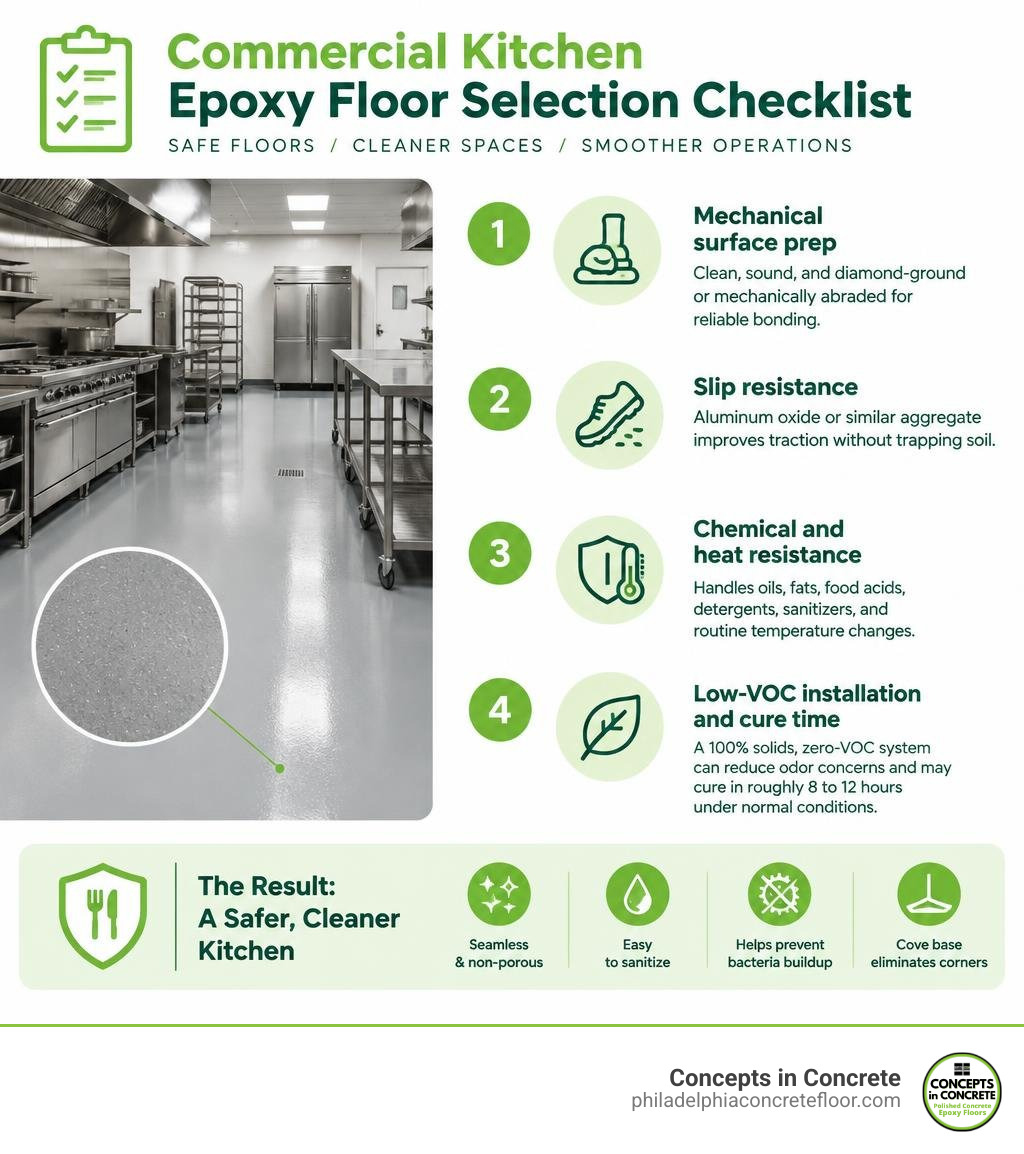
The best commercial kitchen epoxy floor coatings create a seamless, non-porous surface that is easy to sanitize, resists grease and common cleaning chemicals, and includes a cleanable non-slip texture for wet areas. Choose a system only after confirming these essentials:
- Mechanical surface prep – Concrete, tile, or existing coatings must be clean, sound, and diamond-ground or otherwise mechanically abraded for reliable bonding.
- Slip resistance – Aluminum oxide or similar broadcast aggregate improves traction around dish stations, cook lines, and walk-ins without creating a surface that traps soil.
- Chemical and heat resistance – The floor should handle oils, fats, food acids, detergents, and sanitizers, plus routine temperature changes.
- Low-VOC installation and cure time – A 100% solids, zero-VOC system can reduce odor concerns in occupied facilities and may cure in roughly 8 to 12 hours under normal conditions.
Epoxy is not automatically food-safe just because it looks smooth and glossy. The system must be properly specified, installed over a stable substrate, and maintained without harsh cleaning methods that can wear down the finish. In food-service spaces subject to USDA, FDA, or HACCP requirements, seamless floors can support sanitation programs by eliminating grout lines and other porous joints where moisture and debris can collect. For a broader look at how resinous systems compare with other industrial flooring options, the epoxy overview from Wikipedia explains the chemistry behind these coatings.
I am John Muldoon, President of Concepts in Concrete, with more than 23 years of construction experience managing epoxy, resurfacing, and concrete flooring projects ranging from small garages to 100,000-square-foot facilities. This guide draws on that practical experience to explain how to select and protect commercial kitchen epoxy floor coatings that stand up to traffic, spills, cleaning, and daily operations.
Why Commercial Kitchen Epoxy Floor Coatings Are Essential for Food Safety
Commercial kitchens operate under intense scrutiny from local health inspectors, the USDA, the FDA, and facility-specific HACCP (Hazard Analysis Critical Control Point) plans. In these demanding environments, traditional flooring options—such as quarry tile with porous cementitious grout—often fail over time. Grout lines absorb moisture, grease, animal fats, and food particles, transforming the floor into a breeding ground for bacteria like Listeria, Salmonella, and E. coli.
A seamless resinous flooring system eliminates these joints entirely. By creating a monolithic, non-porous barrier, epoxy prevents moisture intrusion into the underlying concrete slab. When combined with an integral cove base—where the floor coating transitions seamlessly up the wall by 4 to 6 inches—it eliminates the 90-degree corner where dirt and stagnant wash water typically accumulate. This allows your team to spray down and sanitize the perimeter quickly and thoroughly.
Chemical Resistance and Thermal Shock in Hot-Line Zones
The cook line is the ultimate testing ground for any floor. Line cook stations endure constant exposure to hot vegetable oils, animal fats, vinegar, citrus juices, and harsh alkaline sanitizers. Unprotected concrete or inferior coatings will soften, blister, or dissolve under sustained contact with hot grease and aggressive cleaning chemicals.
High-performance commercial coatings are formulated to withstand these corrosive agents without degrading. In addition, areas near commercial dishwashers, steam kettles, and tilt skillets face routine thermal shock—rapid cycling between boiling hot wash water and ambient temperatures. A properly engineered epoxy system flexes with these thermal shifts to prevent cracking, softening, and premature failure.
Non-Slip Safety vs. Ease of Cleaning
Wet floors covered in water, cooking oil, and soap represent a serious slip-and-fall hazard. However, balancing traction with cleanability is one of the most misunderstood aspects of commercial kitchen floor design.

If a floor is too smooth, it turns into an ice rink when wet. If it is excessively rough, it will shred standard string mops and trap grease in its crevices, frustrating kitchen staff during nightly cleanups.
To achieve the ideal balance, we broadcast a fine-to-medium aluminum oxide or silica quartz aggregate directly into the wet resin coat before sealing it with a protective topcoat. Aluminum oxide provides sharp, durable angular edges that maintain a high dynamic coefficient of friction (DCOF) even when submerged in soapy water, while remaining smooth enough for squeegees and deck brushes to clean effectively.
Choosing the Right System: Multi-Layer Systems vs. 100% Solids Formulations
Selecting the right chemistry depends on your kitchen’s operational schedule, ventilation constraints, and long-term durability needs. Most commercial applications rely on either multi-layer systems or high-build, 100% solids epoxy formulations.
Comparing System Types: Commercial Kitchen Epoxy Floor Coatings vs. Standard Resins
A popular choice for smaller commercial footprints and light-duty prep areas is a multi-layer restaurant epoxy flooring system. A typical installation achieves a finished build thickness of roughly 12 to 15 mils across moderate-traffic areas.
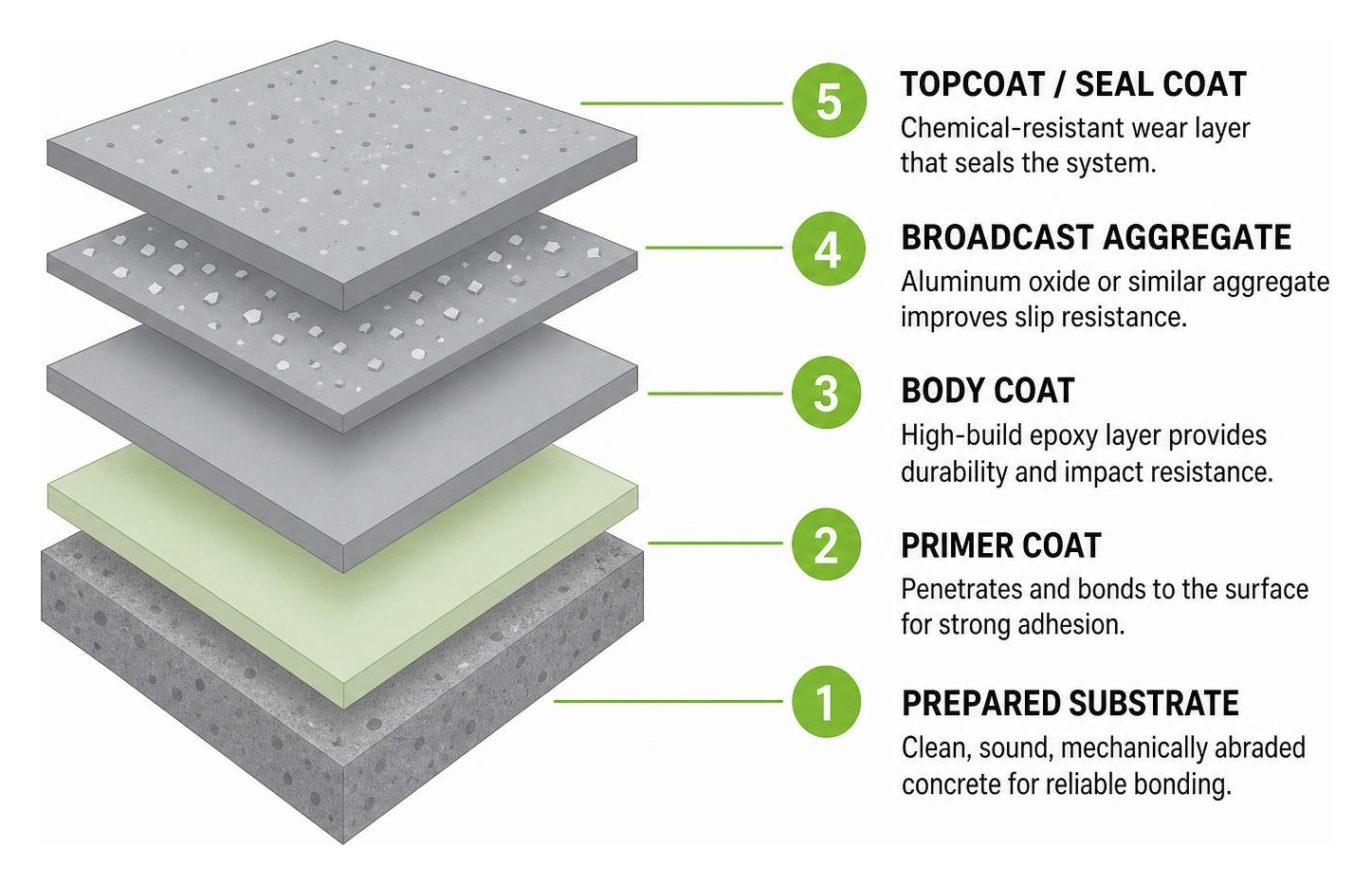
These setups rely on a sequential 3-layer build:
- Moisture-Tolerant Epoxy Primer: Penetrates open concrete pores to seal off moisture vapor and establish a deep chemical bond.
- High-Build Epoxy Base Coat: Fills minor surface imperfections, adds structural strength, and holds the non-slip broadcast media.
- Urethane or Polyaspartic Topcoat: Provides chemical protection, scratch resistance, and UV stability against daily wear.
For larger facilities or 24/7 operations, industrial-grade high-build systems offer added thickness and extreme impact resistance.
Zero-VOC and Rapid-Curing Formulations
In active restaurants, retirement homes, and hospital kitchens, shutting down for days or dealing with strong chemical fumes is out of the question. Traditional solvent-based epoxies release volatile organic compounds (VOCs) that emit strong odors and contaminate open food inventory.
A 100% solids, zero-VOC epoxy system contains no evaporative solvents or water. Because every drop of liquid hardens directly into the cured matrix, there is no off-gassing, shrinkage, or lingering odor during installation. Furthermore, advanced formulations cure within 8 to 12 hours under normal ambient conditions, allowing kitchens to apply coatings overnight and resume prep work the following day.
System Selection Guide
| Feature | 3-Layer Restaurant System | 100% Solids Zero-VOC System | Standard Solvent-Based Epoxy |
|---|---|---|---|
| Typical Thickness | 12–15 mils | 20–40+ mils (or high-build) | 3–6 mils (shrinks as it dries) |
| VOC / Odor Level | Low to Ultra-Low | Zero VOC / Odor-Free | High VOC / Strong Solvents |
| Cure Time to Light Traffic | 12–24 hours | 8–12 hours | 24–48 hours |
| Cleanability | Excellent (with topcoat) | Superior chemical density | Moderate (prone to staining) |
| Best Application | Prep kitchens, small cafes, dry storage | Heavy hot lines, busy restaurants, hospitals | Light utility rooms, low-traffic areas |
Critical Surface Preparation for Maximum Adhesion
Over 90% of coating failures stem directly from inadequate surface preparation. Applying high-end resin over an improperly prepared slab is a guaranteed recipe for failure.
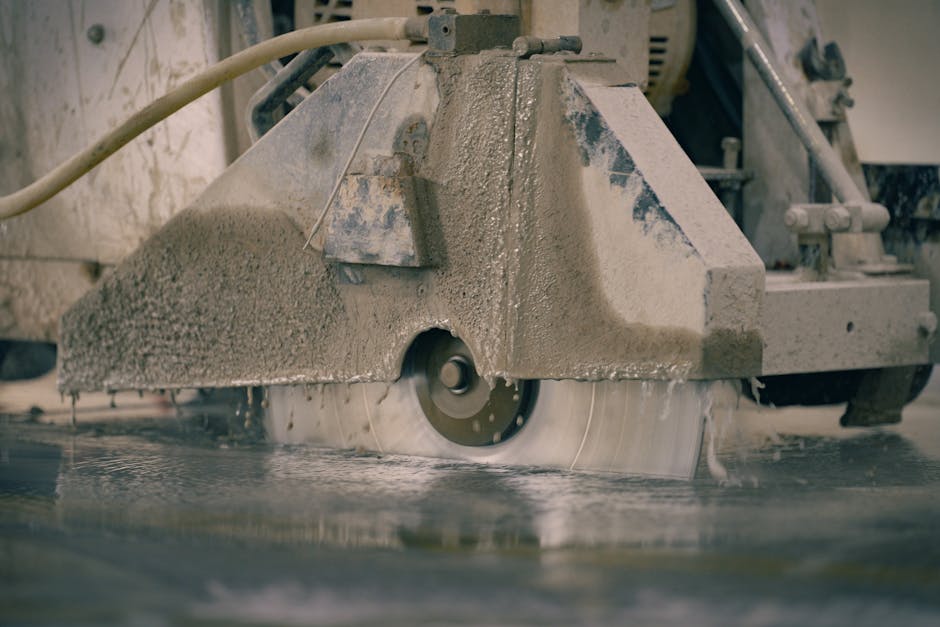
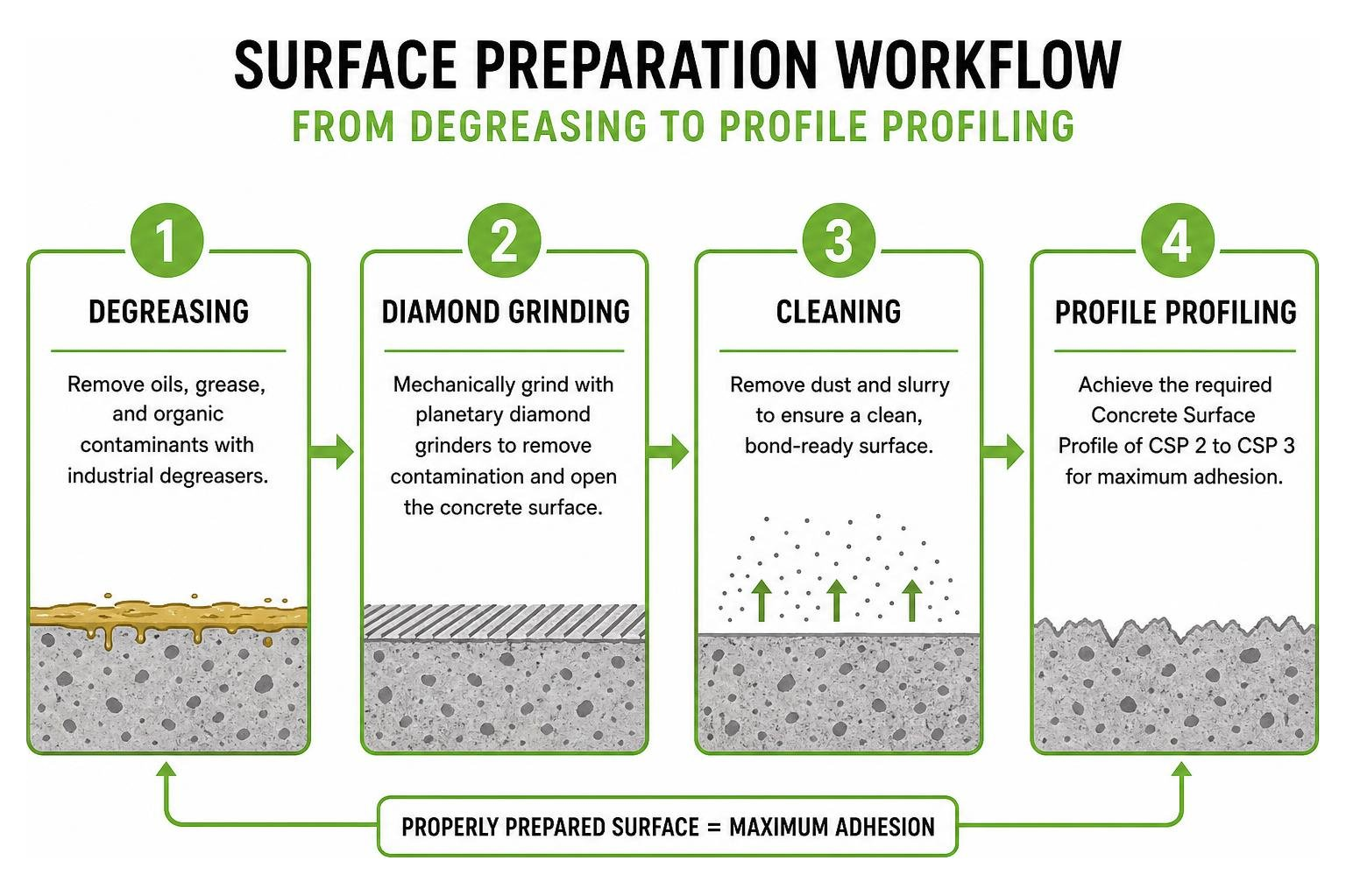
To create a permanent mechanical bond, concrete must be mechanically ground using heavy planetary diamond grinders or shot-blasted to achieve an open Concrete Surface Profile of CSP 2 to CSP 3 (roughly resembling a 60-grit sandpaper texture). Chemical acid etching is never recommended for commercial kitchens because it fails to remove deep grease deposits and can leave residual acid salts that compromise adhesion.
Prepping Substrates: Concrete, Quarry Tile, and VCT
Kitchens rarely present pristine, bare concrete slabs. Here is how different substrates must be handled before coating:
- Greasy Concrete: Years of hot oil penetration require multiple rounds of industrial emulsifying degreasers, followed by diamond grinding down to sound, uncontaminated aggregate.
- Existing Quarry Tile: Tile must be solidly bonded to the substrate. We grind away the vitrified ceramic glaze with aggressive 16-to-30-grit diamond tooling, flatten the grout recesses, and apply an ultra-adherent primer.
- Vinyl Composition Tile (VCT): VCT is not an ideal long-term substrate for heavy commercial cooking lines. If coated, all floor wax, dirt, and moisture must be completely stripped, and a flexible scratch coat must be applied. Whenever feasible, we recommend tearing out VCT down to bare concrete.
- Plywood / Wood Substrates: Wood expands and contracts significantly. Coating wood requires reinforcing fiberglass mesh and a flexible base coat to prevent reflective cracking.
Preventing Common Epoxy Failures
Avoid these common installation mistakes to keep your floor in peak condition:
- Delamination: Caused by applying epoxy over grease, residual sealers, or unground concrete. Mechanical profiling is mandatory.
- Moisture Blistering (Osmotic Action): Deep ground moisture migrating upward can create hydraulic pressure, blowing bubbles through cured epoxy. Always test concrete for Moisture Vapor Emission Rate (MVER) before coating.
- Inter-Coat Adhesion Failure: Missing the recoat window between primer, base coat, and topcoat causes layers to peel apart. If a coat cures beyond its recoat window, it must be mechanically deglossed before the next layer goes down.
- Pinholing / Outgassing: Trapped air escaping porous concrete creates tiny craters in wet epoxy. High-grade penetrating primers effectively seal these microscopic pores.
Professional Installation vs. DIY Commercial Kitchen Epoxy
Applying a DIY boxed kit may look simple on paper, but commercial kitchens present harsh environmental hurdles that leave little margin for error.
DIY roller kits are typically thin (under 5 mils) and lack the high-solids density needed to handle heavy rolling equipment, dropped sheet pans, and industrial degreasers. Professional installers use heavy 480-volt diamond grinding equipment, continuous dust containment systems, self-leveling gauge rakes, and commercial topcoats designed for decades of service.
Cost and Lifespan of Commercial Kitchen Epoxy Floor Coatings
Investing in high-quality resin pays dividends over the floor’s operational lifecycle:
- Standard Systems: Multi-layer commercial coatings designed for light-to-moderate prep areas provide dependable daily performance and hygiene.
- Professional Systems: Fully installed turn-key systems—including heavy diamond profiling, structural patch work, integral cove base installation, 100% solids base coats, and chemical-resistant topcoats—provide high return-on-investment through a 10 to 15+ year operational lifespan under rigorous cleaning conditions.
Warranties, Lifetime Guarantees, and Exclusions
Reputable commercial manufacturers back their products with dependable performance warranties or Lifetime Promises against verifiable defects such as spontaneous delamination, chemical softening, and curing failures.
However, keep in mind standard warranty exclusions:
- Substrate movement, structural slab settling, or expansion joint cracking.
- Moisture vapor transmission exceeding verified system thresholds without an appropriate moisture barrier primer.
- Exposure to unapproved industrial acids or extreme temperatures outside the design specifications.
Frequently Asked Questions About Commercial Kitchen Flooring
Can commercial epoxy be installed over existing quarry tile or VCT?
Yes, provided the underlying floor is structurally sound and firmly anchored. Quarry tile must be heavily diamond-ground to completely remove its glossy ceramic glaze, and grout joints should be filled flush with a patching compound before priming. While VCT can occasionally be coated after stripping all finish wax and testing adhesion, the preferred approach in high-heat commercial kitchens is tearing out tile down to bare concrete.
How fast can a commercial kitchen return to service after coating?
Rapid-curing 100% solids epoxy formulations cure to handle light foot traffic in 8 to 12 hours under normal conditions (70°F and 50% relative humidity). Heavy equipment, rolling carts, and full washdowns can typically resume within 24 to 48 hours, making overnight weekend installations practical.
How do you prevent epoxy floors from turning yellow in restaurant environments?
Standard epoxy base coats naturally yellow when exposed to sunlight or intense interior fluorescent lighting. To ensure long-term color stability, install a high-grade aliphatic polyurethane or polyaspartic topcoat with built-in UV inhibitors. This protective shell resists ambering and preserves a bright, clean appearance.
Conclusion
A durable, seamless commercial kitchen floor protects your business against slips, cross-contamination, health code violations, and costly operational shutdowns. From moisture-blocking primers to non-slip aggregates, every layer works together to keep your staff safe and your workspace sanitary.
For over two decades, Concepts in Concrete has delivered functional, long-lasting flooring solutions across Philadelphia, PA, Doylestown, PA, Cherry Hill, NJ, Princeton, NJ, and surrounding communities. Whether you run a bustling local restaurant or manage a large-scale food packaging plant, our skilled crew guarantees high-performance floor installations done right the first time.
Ready to upgrade your kitchen? Contact Concepts in Concrete today to schedule your on-site assessment and discover the difference of epoxy garage floor coatings and commercial resin installations engineered for heavy daily service.
Call us today at 215-607-6688 or Contact Us by email
© 2004-2026 Concepts in Concrete Bristol PA | All Rights Reserved | Powered by Rettig Digital